cross-posted from: https://atomicpoet.org/objects/3d9c9c3e-14e9-446f-9d5c-83af4227bbfc
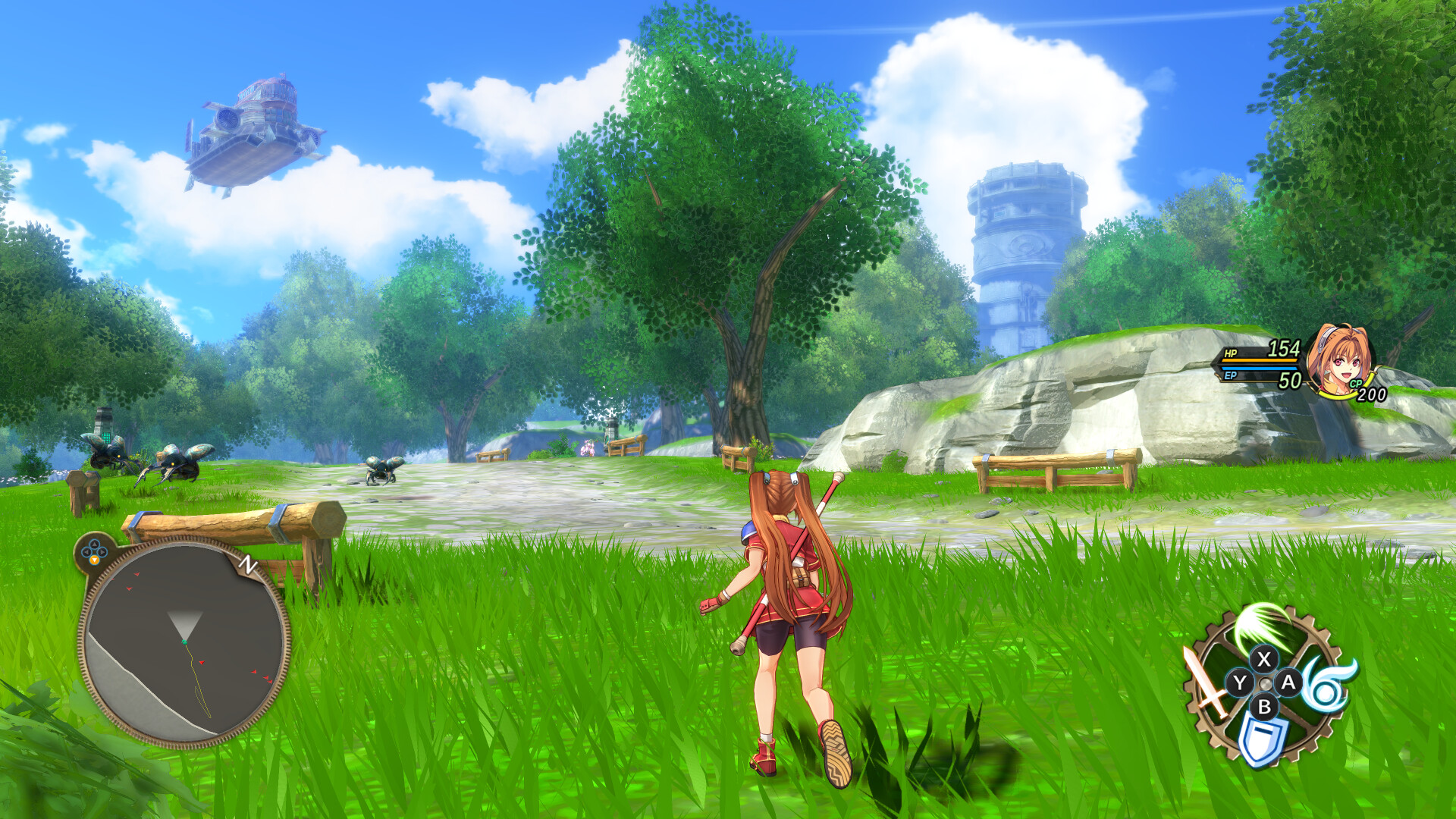
Trails in the Sky 1st Chapter, a JRPG, just got released on Steam—and this is a big deal because this game is to PC what Final Fantasy VII was to PlayStation.
You play as Estelle Bright, a stubborn but big-hearted teen, and her adopted brother Joshua, calm and secretive, as they work as junior agents of the Bracer Guild—mercenaries who handle everything from lost pets to bandit raids.
What begins as simple small-town jobs in the idyllic kingdom of Liberl slowly peels back into a slow-burn political thriller about coups, ancient technology, and rival nations circling like sharks. The genius of Trails in the Sky is how it ties everyday people and personal stories into that larger web of conspiracies, making the upheaval feel like it’s your neighbours and your home on the line.
Some history is in order. The two most influential JRPG developers are Square Enix and Nihon Falcom. Square Enix gave us Dragon Quest and Final Fantasy. Nihon Falcom gave us Dragon Slayer and Ys. Square pushed the turn-based JRPG. Falcom’s big innovation was the action JRPG.
Dragon Slayer in particular was groundbreaking—without it, there’s no Zelda, no Hydlide, no Neutopia. It was the template for action RPGs to follow, and it was so successful it spawned spin-offs. One of them was The Legend of Heroes. That series was so successful it spun off again into Trails in the Sky. And yes—Trails itself kept spinning into more games, until it became a saga of its own.
So why haven’t you heard of it? Because Falcom wasn’t console-first like Square. Their heyday was the PC-88 and PC-98—computers that never came west. When Japan switched to Windows, so did Falcom. Trails in the Sky first arrived on Windows in 2004—but only in Japan. A PSP port followed in 2006. Still Japan only. North America finally got it in 2011… on PSP. By then, nobody here was playing PSP anymore.
It wasn’t until 2014 that the Windows version—better than the PSP one—was localized and released on Steam and GOG. It took more than a decade for Westerners to notice. But once they did, they realised this wasn’t just another RPG—this was a landmark.
The comparison to Final Fantasy VII is apt. Trails in the Sky is Falcom’s premiere JRPG. It cemented their reputation for long-form storytelling and kicked off a serialized epic that continues today. And if you think there are a lot of Final Fantasy games, Trails makes it look modest.
The difference is in the type impact each had. Final Fantasy VII was an atomic bomb. Trails in the Sky was a hurricane—starting as a whisper, then building into a storm. Westerners know the sequels like Trails of Cold Steel and Trails from Zero, but how many ever went back to the original?
Now they can. Trails in the Sky 1st Chapter is a re-imagining of that first game. And “re-imagining” is exactly the right word. Same story, not a simple remake.
What’s new? A lot. The original was purely turn-based. This version lets you switch on the fly between the classic grid system and a new real-time action mode. Combat feels fluid and layered, and Falcom themselves estimate about 80 hours to clear—double the original’s runtime—thanks to extra quests and expanded exploration.
The graphics are completely redone. The old game was 2.5D isometric sprites—think Diablo with anime characters. The new one is full 3D, third-person, HDR-enabled, yet still faithful. Rolent, the first town, looks like you remember, just rebuilt in polygons.
Sound has levelled up. Fully animated cutscenes. Professional actors in both Japanese and English. Steam even lists French, German, and Spanish text, though only English and Japanese get full voice tracks. Most importantly, Falcom’s iconic music is intact—because unlike too many remakes, they didn’t dare mess with perfection.
Controls are flexible. The devs push gamepads, but keyboard and mouse works beautifully. Xbox and PlayStation controllers are supported natively, and thanks to Steam Input, just about anything—Logitech, 8BitDo, you name it—will work.
Steam officially says Windows-only and lists Deck support as “unknown.” But previews already note it runs smooth on Deck, looks gorgeous on OLED screens, and will almost certainly get the “Verified” badge. I tested it myself on Linux—it’s flawless.
Specs are reasonable: Ryzen 5 1600, 8GB RAM, GTX 1050, and 33GB storage will net you 60fps at 1080p.
The price is steep—C$77.99. Steam also launched it with a pile of optional DLC: costumes, boosters, items. Normally I’d balk at paying that much. But this is Trails in the Sky 1st Chapter—rebuilt so a new generation can see why it’s legendary. And if that’s still too much, the 2014 version is cheap: C$21.99 on Steam, or just C$11.00 on GOG.
Reception so far is glowing. Steam already shows a 96% positive rating across 233 reviews. Players love the balance of modern upgrades with old-school heart.
Either way—whether you buy today’s re-imagining or grab the older version—you owe it to yourself to play Trails in the Sky. Because if you care about JRPGs, even a little, this is the one you don’t skip.
https://store.steampowered.com/app/3375780/Trails_in_the_Sky_1st_Chapter/
@videogames@piefed.social
At least the year of PC gaming!
Cool your jets kid. I wanted to pick this up but your obnoxious tone made me want to brush it off. I guess I’ll go play something else then.
This comparison really feels strained. FF7 was the PS1’s biggest game, and by far. It was a revolution that shook the entire industry.
Trails is a cult classic that’s beloved by a niche fanbase, and I’m happy to see this kind of game get a shot at wider recognition here, but its impact was in no way even remotely comparable to FF7.
Okay, but I’m not talking about commercial appeal. I’m talking about artistic achievement.
What Nihon Falcom accomplished with this game is unmatched. Trails in the Sky is, without question, the most expansive and intricate saga in JRPG history.
Because unlike other series that reset with each new title, Falcom committed to one continuous world. Every town, every political faction, every character connects across dozens of games.
And this game was the beginning of it all.
What part of this is comparable to FF7?
The big thing about FFVII when it came out was the huge—for the time—fully realized world.
It felt like stepping into a movie. There was nuance. And there were story curveballs.
Same deal with Trails in the Sky. Fully realized world—immense. And the narrative ambition is not just huge, Nihon Falcom actually pulled it off.
The big thing about FF7 was that it came out during a critical transition period for the industry, and Squaresoft put the highest budget of any video game to date into making sure FF’s jump to 3D graphics was as explosive as possible. The game was heavily marketed on its technical merits, boasting about how everything this game does could only be possible on PS1. It’s full of setpiece moments that are literally just Squaresoft trying to show off their VFX budget (this is why summon cutscenes are so absurdly long). And it blew audiences away because no one had never seen anything like it before. FF7 was a revolution.
Trails certainly has good reason to be beloved by its niche fanbase, but by 2004, it really wasn’t doing anything super unique compared to its contemporaries from the same time period. It’s a polished game, but I can’t describe it as anything more than an evolution.
Not to mention it was amid a crashout with Nintendo where Square struck a deal with Sony making the Playstation a sudden major contender.
But we’re not talking about technical merits but artistic.
There is no RPG series as big and immense as Trails.
This is Nihon Falcon’s crowning achievement. In terms of sheer craftsmanship, only one other JRPG compares.
Just because something is big and difficult, doesn’t mean it’s good or fun. I still need to play it to see if I like it, but the reasoning used here is flawed.
The technical merits were why FF7 was so impactful as a cultural landmark of video game history.
Is Trails a good game? Sure.
Is FF7 the right comparison to invoke? Not even close.
The technical merits mattered when it launched. Do they matter now? Not at all. Otherwise FFVII would’ve gone the way of Battle Arena Toshinden—big splash at the time, forgotten in the long run.
What gives FFVII its staying power is the art. That’s why we play games. Not for specs. For creativity.
And this is where FFVII and Trails meet: at the rarefied height of JRPG artistry. The pinnacle. God-tier.
What Nihon Falcom accomplished with this game is unmatched. Trails in the Sky is, without question, the most expansive and intricate saga in JRPG history.
Alright, I don’t think this is true lol… Just an FYI, I’m generally defending you against the person here who apparantly really likes FF7 and really hates Trails games, but… Yeah I don’t think that’s “without question” at all. In fact, I myself am questioning it right now.
Again, what other series is comparable? 12 games, multiple but interlocking arcs, developed over decades.
If there’s one that I don’t know about, tell me.
For all the good things about Trails there’s a lot of flaws as well. There’s a lot of weak plot lines, reused assets (lack of npc variety being one) and there’s quite a few logical leaps happening as the series has progressed. The games are ambitious for sure, but let’s not pretend that hasn’t had its own shortcomings.
For me Trails as a series is very much a case of being better than the sum of its individual parts, and that great, but you’re vastly overselling the importance of this series. I enjoy both Trails and Final Fantasy, but it’s wild to put them on the same field like this. Square Enix has more than 5000 employees. Falcom has about 80, I think. The scale is so wastly different.
Trails in the Sky is, without question, the most expansive and intricate saga in JRPG history.
You have Derek Smart levels of ignorance and hubris.
Hyperbole, much? What a bananas way to say you like a fun remake of a relatively solid JRPG.
This whole post screams “AI advertisement” to me tbh
I’ve been on the Fediverse for a very long time. If you Google my username, you’ll find a trail of posts going back years—thousands of them. My style has always been consistent, and I’ve stayed true to it.
I also happen to be autistic, and I often use ChatGPT for tone checks—it’s a tool that helps me communicate more clearly.
This isn’t an ad. I’m just someone who genuinely loves this game. And if enthusiasm makes me look like a shill, then so be it.
That said, your comment is a good reminder of why I recently added two new rules to !videogames@piefed.social, the community I moderate.
If it’s bananas, tell me why.
Your only arguments for your statement in this thread are, that there are a lot of Trails games, and that the games are all connected. Comparing this to FF7 seems like a real stretch.
If these games are so important, how about some examples of how they influenced gaming and their impact, either to devs or gamers.
BTW I think the Trails series is garbage and has only one good game in it.
I’d even say the interconnectedness is often more of a handicap.
There’s one character in Sky whose arc is postponed into Azure. It…doesn’t fit with that larger narrative. Then, the biggest criticism of some of those later games is how there’s too many characters around. Most were enjoyed when first introduced, but then there’s way too many. In a lot of ways it suffers the same ways later Marvel movies do; banking on audience members shouting “I know what that is!!”
Supposedly some more recent games refocus on smaller groups but are still very much about “building a larger narrative”. I can’t claim I’ve played all of them to get a larger opinion, but Kingdom Hearts did a lot of that, and we saw its failed payoff in Kingdom Hearts 3 (actually something like KH8). I still enjoy the first two games in the series - the duology this one is remaking - but I’m pretty sick of the obsession with lore.
A video I watched even discussed how early Star Trek movies had blatant plotholes with earlier establishment, but that was fine because it was better to focus on the narrative the director wanted.
You’re missing why Trails matters.
This isn’t about “a lot of games.” It’s about building something no other JRPG studio has ever pulled off—a single, continuous saga that’s been unfolding since Trails in the Sky in 2004.
No resets, no reboots, no discarded lore. Every event, faction, and character connects across a dozen titles. That kind of long-form narrative discipline doesn’t exist anywhere else in the genre.
And don’t minimize how hard that is. Most JRPG studios can barely keep one trilogy coherent. Falcom has been weaving one uninterrupted storyline for over twenty years—through console generations and shifting hardware.
Holding a narrative together across decades isn’t just impressive, it’s almost impossible. Doing this wasn’t just because of luck. It’s taken discipline, patience, and vision on a scale no other studio has matched.
Influence is easy to trace. XSEED’s Trails in the Sky localization raised the bar for how seriously Western publishers approach text-heavy JRPGs. At the time, bringing over a game with hundreds of thousands of lines of dialogue was considered unworkable. They did it, and it set a precedent for the kind of effort fans now expect from localizations.
Falcom also helped legitimize PC as a JRPG platform in the West—back when most people dismissed the genre as “console only.”
And if you look at modern RPGs built around serialized storytelling and grounded politics—Disco Elysium, Baldur’s Gate 3, even the way Persona 5 structures its arcs—you can see Falcom’s fingerprints everywhere.
Critics agree. RPG Site flat out said this about the remake of Trails in the Sky FC:
If you’re here strictly for the magical number, here it is: Trails in the Sky 1st Chapter remake is a 10/10. What’s more, it’s the easiest 10/10 I’ve ever given.”
https://rpgsite.net/review/18452-trails-in-the-sky-1st-chapter-review
And the numbers back it up. Trails in the Sky sits at Overwhelmingly Positive on Steam with a 93% approval rating from thousands of reviews. Recent reviews are even better—96% positive.
https://store.steampowered.com/app/251150/The/_Legend/_of/_Heroes/_Trails/_in/_the/_Sky/
Rather than burning energy on outrage, put that time into actually playing more games. You’ll get more out of them—and you’re better than just dismissing something this significant.
Ok well, then that’s definitely not like Final Fantasy 7.
Final Fantasy games are in their own contained universe.
Clearly the potboilers on your team don’t know what they’re talking about and are just saying bullshit to drum up hype so they can make money.
Rather than burning energy on outrage, put that time into actually playing more games. You’ll get more out of them
Fuck off with that nonsense. You’re here to sell a product and take people’s hard-earned money. They shouldn’t lower their standards to satisfy your ego and make you more money.
You should work harder because I guarantee your team didn’t put as much effort into this as went into FF7.
Some people are just fans of video games, dude. And get this, sometimes you’ll disagree because it’s all subjective.
Real weird, gatekeep-y argument here.
You can get ignored, too.
I’m tired of people with no standards.
I believe you’re vastly overstating the importance of this game and franchise. As I said, I think it’s a terrible series of games (and I’ve played them up to CS3), so there’s absolutely some bias here.
Also, what does other people’s review have anything to do with how impactful or important something is to the medium? Does this mean that the Hentai game Mirror with ~96% positive, 85k+ reviews on Steam is even more significant than Trails?
And if you look at modern RPGs built around serialized storytelling and grounded politics—Disco Elysium, Baldur’s Gate 3, even the way Persona 5 structures its arcs—you can see Falcom’s fingerprints everywhere.
Please show me where those fingerprints are, because I don’t see them.
There might be some fringe impacts Trails has had on the industry here and there, but the only big influence it has had is on Honkai: Star Rail’s combat system. And at this point, HSR is so much larger than the Trails series as a whole that it’s going to look like Meucci’s contribution to telephone technology when all is said and done. Expedition 33 already took some of its UI design from HSR.
Even the impact of Trails’s hybrid action/turn-based system is debatable because Trails through Daybreak was in development at the same time as Metaphor: ReFantazio, which uses the same system. Ultimately, the series serves a very specific, small niche within a niche, and it’s never going to be a major trailblazer for the same reason much of Baldur’s Gate 3’s story design won’t be: that kind of narrative structure is not an efficient way to make money. You have to be an auteur or a major risk taker to do software engineering that way.
Meanwhile, Final Fantasy VII’s impacts on the entire industry, let alone the genre, are too numerous to list. The two series are not remotely comparable. OP’s neck-deep in atomistic fallacy here.
This shit is bananas. “Change my mind”
It’s not like FF7 and you should get your heads out of your collective asses.
Is it not like FF7 because you don’t think the series is good enough to be mentioned alongside it? Or because it’s not about eco-terrorists and fascist corporations destroying the planet?
I’m still confused on the sentence “re-imagining is exactly the right term”, because to me imagination is fluid and ever changing, but they said this term means the story has not changed.
I would expect remaster to be the proper term here, but I’ve not played the original or seen this iteration so I’m not sure what to think.
I feel like they were paid by the creators to write this.
Some history is in order. The two most influential JRPG developers are Square Enix and Nihon Falcom. Square Enix gave us Dragon Quest and Final Fantasy.
Uhh… credibility lost. They’re saying history is in order and they immediately begin by rewriting history.
Squaresoft and Enix were two different companies for decades, particularly when they were giving us Final Fantasy and Dragon Quest.
Notice I wrote in present tense, not past tense. Square Enix are one company now.
Notice I wrote in present tense
Immediately after saying “some history is in order”.
Square Enix didn’t give us the original Final Fantasy nor the original Dragon Quest. They give us those games now. But writing as if they were always one company feels like rewriting history.
I think there might be a small misunderstanding. I wasn’t saying they’re one company—just noting the influence they both still carry today. However you look at it, Square Enix are the caretakers of Final Fantasy and Dragon Quest, much like how Bandai Namco continue to carry Pac-Man forward.
Instead of focusing on the negatives, why not celebrate what these games have meant to so many of us? Their impact is still worth appreciating.
this game is to PC what Final Fantasy VII was to PlayStation
Fuck off.
You’ve been on lemmy for a day and have replied to this post bashing the OP like 5 times. Relax.
You mean I scrolled through a thread and replied to comments I saw?
Yeah, ignored.
Not that you’ll see this, but I mean that you’re being incredibly rude, argumentative and a bully towards them. You can disagree with someone without being a dick about it. This Lemmy instance is becoming more like the reddit game subreddit by the day, I swear.
/Games generally has a content problem; it’s okay for people to bring up other discussions.
If you want to argue there are more interesting things to be on the front page than reviews gushing about a new game, even if using overblown wording, then please, post this other content and let the lesser stuff drift to the bottom! Entering the comment thread and telling people to fuck off isn’t a useful way to go about it though.
Nah, I’m good.
If you have a problem with what I’m doing, you can always ignore me.
I personally don’t have any issue with what I’m doing so I see no reason to change.
It doesn’t bother me if it bothers you.
Everyone is critic, but not everyone is a good critic. Toxic positivity exists so people can get taken for a ride without fear of judgement.
“Toxic positivity” is not bannable. Toxic negativity is.
So, consider this a word of caution. If you found the game stupid, say that, and use informed language to describe why it’s not worth people’s time. But the community rules don’t let you target that attitude to people and their threads, or to make no-effort dismissals of people. If you don’t care, prove it by taking your attention elsewhere.
Hoping you get to keep posting here, and rethink your attitude!
Welcome to my blocklist.
So tired of arguing with people like you.
Too bad they botched the deluxe edition / season pass release.
Never bought the deluxe edition—so I don’t know.
What’s the whole purpose of them other than just giving devs more money?
The dlc is important to some, to each their own.
It is pretty shitty to fail to release something and then go radio silence about it with no real explanation, though. On top of the regional pricing issue too.
Question wasn’t rhetorical. I really don’t understand the purpose of deluxe editions nor their importance.
I always just assumed people spend the money because they like spending it.
Deluxe editions for games usually come bundled with DLC for a cheaper price than buying them and the game individually. Take older Call of Duty games for example, where buying the game and each DLC would cost a total of $120, but the deluxe edition with the same content would only cost you $100. So if you knew you were going to end up buying all four DLC, getting the deluxe edition was much cheaper.
In this particular game, I don’t know exactly what will end up in the deluxe edition but there’s already $72 worth of DLC so I imagine a lot of it is going to be included.
Follow-up question: how much does DLC actually tend to change the core game?
Are these just aesthetics or does it change things hugely?
For Trails games: not at all. Usually only cosmetic items like costumes, and then like item packs that give you x number of healing items or ingredients or whatever.
That would depend entirely on the game. For example, the game Cassette Beasts has multiple DLC. One adds a small amount of actual new content to the game, and the rest are all cosmetic outfits for your characters. None of these cosmetic DLC are worth buying unless you really like the base game and want to support the developers. Then there’s games like The Binding of Isaac: Rebirth, where each of the DLC is a massive expansion to the base game, with the DLC having more content than the base game does at this point and are highly worth getting.
As far as Trails in the Sky is concerned, I know some of its DLC is cosmetic stuff and a lot of it gives you packs of in-game consumables. Doesn’t seem incredibly useful to me, but idk much about the game so I could be wrong.
Even though the gushing about Trails in the Sky may be seen as overblown, it’s interesting to read about the console history of these games and what they influenced. I remember when I played a Neptunia game and they stated “You know how every RPG has you fighting slimes first?” I thought “What…? No. I literally can’t think of any.” I realized those creators had very much grown up off of the “Dragon Quest” side of the RPG world. It seems to make sense to say Legend of Zelda in some ways followed some cues from the Ys games.
I played the original FC in 2019. I think while it makes sense to be called a slow burn, there were also elements of the writing that kept me playing even early on; unlike a lot of game worlds it actually feels like a livable place where people trade, travel, have social lives, beyond just “The Soulstealer you’re going to fight has done wonders for our town! The sacrifices are necessary!” And, having the world and characters built up, even if it’s a bit slow, does lead to some excellent moments of payoff. I’m glad FF7 was mentioned, because I remembered that same anticipation for the FMV-style sequences of some epic cutscene battle or chase after a long sequence of investigating. Admittedly, part of what kept me going was the creative localization work. Little things like the “empty chest messages” felt like a very fun developer touch showing how much they enjoy the game.
I think that there’s definitely a “Devoted Falcom crowd” much like many other fanbases now, and I’d expect their opinions to be a bit skewed. When I was looking for opinions on this game, most of them seemed to come from people that had played most of their series. I’m a bit of an outlier - After Sky 1+2, I attempted to play the next three games in the series, through to Trails from Azure, at which point I decided “Eh…I’m done. The magic is lost.” But there’s a good reason that crowd exists, and I think I get how they can really absorb you in for the long haul. I just happened to differently enjoy a single pair of their games. At the very least, I wouldn’t consider the current 96% rating on Steam to be wholly objective; the game hasn’t been out long, so most reviewers will be people who played the game already and have a strong stake.
I played the demo for this one, and was surprised to find myself challenged by the JRPG combat even on normal. It’s possible to solve that issue with grinding, but it also got me to appreciate all the systems they have for outfitting yourself well, and reacting to particular circumstances in combat (I’m thinking of making a guide on Steam to showcase some of these). While I think of these games for their story (and of course their music) it’s interesting to see they have a large following for max difficulty playthroughs.
Oh, I remember this game. Played through almost the whole original (watched the last dungeon on YT) pretty much without grinding. Didn’t like it.
My opinion on the story: nothing happened for 50 hours, and something big finally did, I was already way past the point of disinterest. I’ve seen someone else write that it’s basically setting up the world for what happens later, and the third part almost makes you forgive the creators, but there’s no way I’m playing through another one.
“1st Chapter” concerns me. Is this a complete, stand alone game with a satisfying conclusion or does it’s story ultimately rely on playing later games as well.
The first game has a “neat” conclusion where all seems resolved, that then leads into a stinging cliffhanger based around the characters.
The second game is the one with a satisfying conclusion; do not let people advertise “18 Trails games with DEEP FUCKING LORE” as a way to interest you. I broke off from this series from boredom several games onwards, but Sky 1+2 are a complete story that are absolute bangers.
As I said in my review: this is a re-imagining of the first Trails game. It’s part of a much, much larger saga that continues to this day—but this is a self-contained game.
You don’t have to wait for the rest of the games. The sequels have already been released.
Think of this like Final Fantasy VII Remake. Final Fantasy VII already exists, and you can buy it for cheaper. And, well, same deal with Trails in the Sky.
The price is insane. No way I’m touching it until it’s about $50 cheaper. It doesn’t even have regional pricing for my country which makes it extra expensive by comparison.
The dlc listed has a higher combined cost than the game even as well lol. All this seems particularly egregious for a remake of a 20 year old game.
I don’t know why they thought they could get away with these prices. I’ve never even heard of this game before.
If the total cost was $20 and the dlc was included, I’d consider it…maybe
But DUDE, it’s for the PC what Final Fantasy 7 was for the PS1!
You HAVE to buy it RIGHT NOW!
If it was, we all would have heard about it. Everyone says they are the ffvii of blablabla.

Has the accessibility improved in the decade plus?
The game always wanted me to always know the color weakness of the enemy as a hard requirement, and I physically cannot do that. I am color blind.
I wanted to like it, I tried using a color changing overlay, I tried using tape on the screen to assist. No cigar.
Isn’t one of the more modern Dragon Quest games on PC as well? These series are top-notch and have nice graphics as well.
… No it’s not
Totally is. FFVII was a watershed moment for JRPGs on PSX. Same is true for Trails on PC.
It’s just that recognition in the West for FFVII was instant. Meanwhile, due to localization, it took more than a decade for Trails to get recognition.
Maybe this is a better comparison: if FFVII is The Beatles, then Trails is the Velvet Underground. Beatles sold massive copies immediately. VU took awhile, but now everyone knows they’re just as impactful as the Beatles.
That’s a bad analogy. I just asked 4 of my friends (25-65) if they knew who the Beatles were. Everyone said yes. Then I asked if they knew VU, everyone (including myself) had no clue who that was.
This isn’t going to be as big as you think it is.
Oh boy I’m glad you said that because I didn’t want to sound like an idiot. I’m 40yo and I have no idea who the VU are, nor does comparing them to the Beatles make me excited to look them up.
It’s a really good analogy imo. In that neither VU nor TitS are anywhere as impactful or important to the zeitgeist as the Beatles or FFVII, respectively.
I’d go as far as to say that their analogy actually contradicts and corrects their original claim that FFVII and TitS are in any way equivalent.
Heh TitS…
And you just made my point for me. 🙂
The Velvet Underground are the most important band you’ve never heard about. In many ways, bigger than the Beatles.
Because the Velvet Underground were the precursors to glamour, prog, punk, new wave, noise, alternative, and grunge.
Without the VU, there’d be no David Bowie, Iggy Pop, Ramones, Sex Pistols, or Nirvana.
And the VU were making that kind of music in the ‘60s. Commercial flop, but almost everyone who heard of them started a band.
If you haven’t heard of the VU, you should watch that Apple Music documentary about them. Of course, after you play Trails in the Sky.
All I can say is, if your taste in video games is anything like your taste in music, then I’m right to stay far away from anything you recommend.
Auto-correct changed “glam” to “glamour”, and now lemmy.world won’t let me make the edit.
Anyway, here’s my further opportunity to say that The Beatles changed the world by being everywhere. The Velvet Underground changed the world by changing the people who mattered next.
And if this motivates you to go listen to the Velvet Underground, then I’m jealous—because I wish I could hear the VU for the first time all over again.
What do you mean they won’t let you? There’s no time limit on edits.
You have no perspective on what makes good art.
You are a consumerist at heart.