I am in favour of banning the burqa, but I think it’s particularly funny that the guys who are supposedly all about individual freedom (iniciativa liberal, despite the name they are much closer to libertarians) at least in their propaganda voted in favour of banning face-covering in public (which is what the law actually refers to, because in Portugal, for the time being, it is unconstitutional to ban a specific religious item).
I think the face-covering law is specifically targeting the religious item, especially considering the exceptions to the rule.
If a country banned any pointed objects from being worn around the neck, in case it could be used as a weapon, say, we would all know that was a ban on the crucifix. I believe it’s just a smokescreen, like the surveillance laws being masqueraded as child-protection.
The face-covering law includes items that aren’t the burqa, such as bandannas and mascot/fursuit heads. However, it wouldn’t surprise me if you’re correct in assuming it’s targeting a religious item, especially since the law doesn’t usually get enforced unless it’s a woman wearing a burqa.
It’s a fact that the law was originally introduced by the far right, and specifically banned the burqa. Then it was expanded to include other face coverings, with exceptions.
I would be in favour of banning the use of the crucifix in public too. Not because I think it’s a dangerous object, but because I believe religion should remain at home or in a place specifically designated for that purpose.
Yes, I agree that in an ideal world, religions would not be part of society. However- forcing the issue in our current societies with a top-down ban is absolutely never going to work. People will rebel against this kind of oppression of what they believe, deeply (however foolishly), is their truth and their duty to an omnipotent being.
Education and connection to the rest of the world is the solution to that problem. These things dull religious fervour. But people have been religious for at least as long as we have been able to write. There’s no erasing that in a short few generations, let alone a single election cycle.


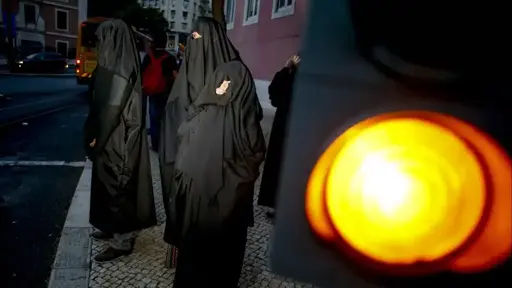
I am in favour of banning the burqa, but I think it’s particularly funny that the guys who are supposedly all about individual freedom (iniciativa liberal, despite the name they are much closer to libertarians) at least in their propaganda voted in favour of banning face-covering in public (which is what the law actually refers to, because in Portugal, for the time being, it is unconstitutional to ban a specific religious item).
I think the face-covering law is specifically targeting the religious item, especially considering the exceptions to the rule.
If a country banned any pointed objects from being worn around the neck, in case it could be used as a weapon, say, we would all know that was a ban on the crucifix. I believe it’s just a smokescreen, like the surveillance laws being masqueraded as child-protection.
The face-covering law includes items that aren’t the burqa, such as bandannas and mascot/fursuit heads. However, it wouldn’t surprise me if you’re correct in assuming it’s targeting a religious item, especially since the law doesn’t usually get enforced unless it’s a woman wearing a burqa.
It’s a fact that the law was originally introduced by the far right, and specifically banned the burqa. Then it was expanded to include other face coverings, with exceptions.
That doesn’t surprise me in the least bit. I will have to look further into this. Regardless, it’s a stupid law.
I would be in favour of banning the use of the crucifix in public too. Not because I think it’s a dangerous object, but because I believe religion should remain at home or in a place specifically designated for that purpose.
Yes, I agree that in an ideal world, religions would not be part of society. However- forcing the issue in our current societies with a top-down ban is absolutely never going to work. People will rebel against this kind of oppression of what they believe, deeply (however foolishly), is their truth and their duty to an omnipotent being.
Education and connection to the rest of the world is the solution to that problem. These things dull religious fervour. But people have been religious for at least as long as we have been able to write. There’s no erasing that in a short few generations, let alone a single election cycle.